

Executive Summary
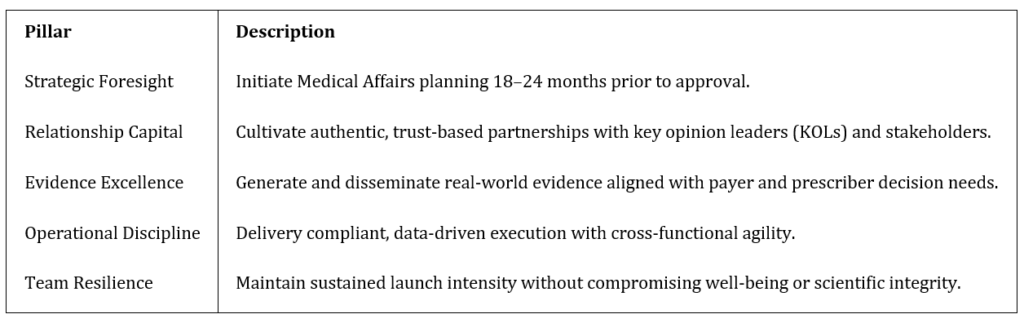
In today’s highly competitive pharmaceutical landscape, Medical Affairs leadership plays a pivotal role in determining whether innovative therapies achieve rapid adoption or underperform. Industry analyses indicate that 40–50% of new drug launches fail to meet revenue expectations, often due not to molecule quality but to how effectively Medical Affairs establishes the scientific and evidentiary foundation for trust, access, and sustained adoption (Bain & Company, L.E.K. Consulting, IQVIA, 2023). This paper presents a strategic framework built on five core pillars essential for launch excellence:
The High-Stakes Reality of Modern Product Launches
Following extensive research and significant investment, FDA approval represents a critical milestone but not the final goal. Clinicians soon encounter their first eligible patients as payers, advocacy groups, and regulators request real-world data beyond pivotal trials. Medical Affairs leadership is central to converting scientific innovation into clinical routine.
- Bain & Company found that nearly half of drug launches fall short of expectations, with 25% achieving less than 50% of forecasted sales .
- L.E.K. Consulting reported about 40% of launches underperform by at least 20% against consensus forecasts .
- IQVIA data demonstrate that new active substance launches post-pandemic underperform pre-pandemic benchmarks by approximately 42% at six months .
These figures underscore a recurring challenge: The complexity lies not in innovation itself but in translating clinical promise into trusted, real-world practice, a role Medical Affairs leads.
Why Medical Affairs Leadership Matters More Than Ever
Medical Affairs has transitioned from a supporting function to a strategic leader of launch success, amidst evolving payer scrutiny, clinician skepticism, and digital transparency. Its unique mandate balances scientific rigor, ethical standards, and evidence integrity to earn stakeholder trust. Key external drivers include:
- Payer Requirements: Real-world outcomes and evidence increasingly guide formulary decisions alongside regulatory approval.
- Clinician Confidence: Physicians rely more heavily on peer-level scientific discourse than on promotional communications.
- Regulatory Complexity: Greater oversight necessitates careful separation of education from promotion within compliance frameworks.
- Digital Influence: Social and scientific media rapidly shape perceptions, requiring vigilant, accurate messaging from Medical Affairs.
Moreover, new modalities such as gene and cell therapies, rare disease treatments, and precision medicines demand comprehensive ecosystem enablement, diagnostic preparedness, and patient-finding strategies, positioning Medical Affairs as the architect of sustainable therapy adoption.
The Strategic Architecture of Launch Excellence
Phase 1: Pre-Launch Foundation (18–24 Months Prior to Approval)
- KOL and Stakeholder Engagement
Develop long-term, scientifically grounded partnerships with clinicians, payers, and advocacy leaders to identify evidence gaps and shape messaging proactively, avoiding the distortions of launch-time urgency. - Evidence Planning
Conduct rigorous gap analyses on pivotal clinical trials to define unmet questions such as safety in underrepresented populations, long-term outcomes, and health economics. Translate these into registries, observational studies, and investigator-initiated trials ready at or shortly after approval. - MSL Team Development
Recruit and train Medical Science Liaisons 6–9 months before launch, emphasizing peer credibility, competitive awareness, and advanced communication skills. MSLs should lead scientific discussions at launch.
Phase 2: The First 100 Days — Precision Execution
Launch demands rapid, precise, and balanced scientific communication:
- Scientific Communications: Secure pre-approval of core materials and optimize medical–legal–regulatory (MLR) workflows to ensure compliant agility.
- Field Intelligence: Systematically gather and synthesize MSL insights via CRM tools and structured meetings to inform strategic adjustments.
- Stakeholder Segmentation: Customize engagement to deliver in-depth science to specialists, pragmatic information to community physicians, outcomes data to payers, and transparency to advocacy groups.
Building the Evidence Engine
Launch marks the start, not the end, of evidence generation critical for payer and clinical decision-making:
- Real-World Evidence (RWE): Initiate studies within 3–6 months post-approval to address real-world clinical and economic uncertainties.
- Registry Collaboration: Establish or contribute to long-term data registries, especially for rare or novel indications.
- Investigator-Initiated Trials: Support independent research to bolster credibility and expand data scope.
- Publications Strategy: Align manuscripts and congress presentations with clinical decision timelines, prioritizing impact over volume.
Medical Science Liaisons: The Field Generals
MSLs personify scientific rigor and stakeholder trust:
- Clearly define non-promotional, evidence-based roles.
- Focus on depth of engagement within territories rather than sheer coverage.
- Measure performance by quality of scientific dialogue, insight generation, and influence on clinical confidence.
- Promote continuous learning, mentorship, and mastery of therapeutic areas.
Cross-Functional Leadership: Navigating the Matrix
Effective Medical Affairs leadership requires alignment and balance across commercial, regulatory, market access, and patient support functions:
- Collaborate with commercial teams while preserving independent scientific voice.
- Integrate compliance proactively with regulatory partners.
- Jointly develop payer evidence and value dossiers with market access early.
- Base patient support initiatives on sound scientific evidence.
- Utilize governance forums such as launch readiness boards to maintain transparency and collaborative accountability.
Critical Success Factors
- Strategic Prioritization: Use Impact–Effort analyses to allocate resources toward activities that measurably drive launch success.
- Data-Driven Agility: Focus on leading indicators such as engagement quality and evidence milestones rather than lagging revenue metrics.
- Scientific Credibility: Protect objectivity vigilantly; regained trust is rare.
- Team Resilience: Manage launch intensity as a sustained effort—plan capacity, celebrate successes, and foster work-life balance.
Common Pitfalls
- Premature Action (“Ready–Fire–Aim”): Avoid sacrificing strategic clarity for rapid activity.
- Isolated Perspectives: Seek diverse stakeholder input beyond familiar KOLs.
- Superficial Metrics: Prioritize outcome-linked measures over activity counting.
- Approval Endpoint Mindset: Regard regulatory approval as a launch start, not the finish line.
Post-Launch Evolution
Shift focus from launch intensity to enduring scientific leadership:
- Advance evidence maturation through RWE and HEOR publications.
- Specialize MSL focus toward access, outcomes, or patient engagement domains.
- Systematically capture learnings for lifecycle management and subsequent launches.
The Future of Medical Affairs Leadership
Emerging forces will redefine launch approaches:
- Precision Medicine: Seamlessly align diagnostic and therapeutic evidence strategies.
- Digital Transformation: Harness virtual engagement, AI analytics, and hybrid communication models.
- RWE Acceleration: Integrate real-time EHR, claims, and specialty pharmacy data.
- Stakeholder Expectations: Offer transparent, personalized, evidence-based engagement.
- AI and Ethics: Deploy machine learning for insight synthesis within ethical governance and human oversight.
Practical Recommendations
- Initiate Medical Affairs planning 18–24 months pre-approval.
- Foster authentic, scientific exchange with KOLs, payers, and advocacy partners.
- Align evidence generation tightly with payer and prescriber decision points.
- Train and deploy MSL teams early with emphasis on scientific depth and strategy.
- Emphasize compliance as fundamental to stakeholder trust.
- Continuously capture and translate field insights into evolving strategy.
- Measure trust, impact, and adoption rather than volume alone.
- Prioritize team well-being to sustain launch excellence.
Conclusion: The Measure of Leadership
Medical Affairs defines the translation of groundbreaking science into accessible medicine. Leadership is measured not by activity quantity but by the quality of outcomes:
- Did clinicians trust the evidence?
- Did patients gain timely access?
- Did real-world data advance clinical practice?
By integrating science, strategy, and ethics, Medical Affairs leaders ensure innovations deliver commercial success alongside lasting patient and societal benefit.
About the Author
Denis Katz is a Medical Affairs and Clinical Development strategist with more than 18 years guiding therapies from early development through global launch. Through Salience Clinical, LLC, he advises pharmaceutical and MedTech organizations on harmonizing evidence generation, stakeholder engagement, and regulatory strategies to accelerate therapeutic access.
📧 denis.katz@salienceclinical.com
🔗 LinkedIn
🏢 Salience Clinical, LLC — “We Bring Salience to Science.”