
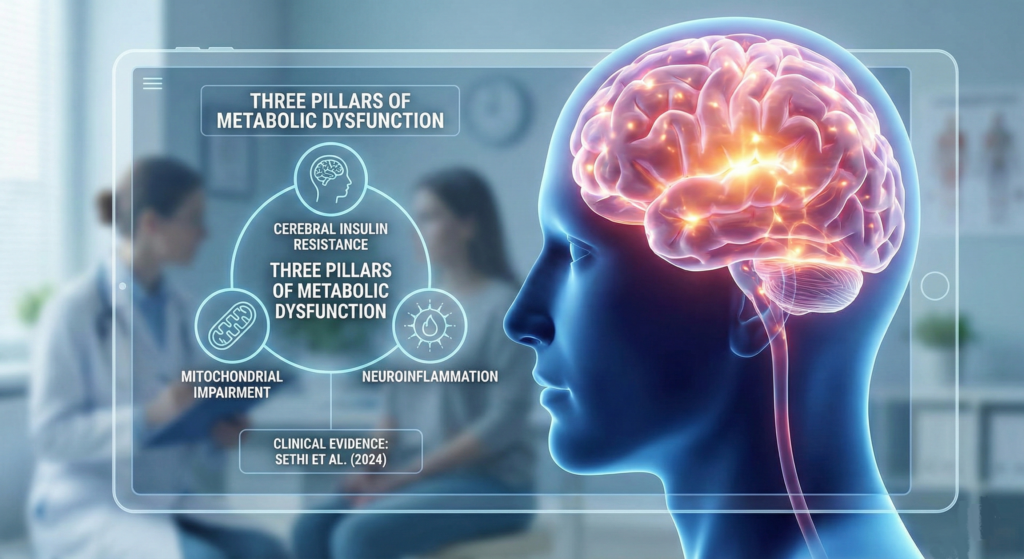
The traditional boundaries between metabolic health and psychiatric care are dissolving. At Salience Clinical, we view the brain not in isolation, but as the most metabolically demanding organ in the human body. While comprising only 2% of total body mass, the brain consumes approximately 20% of the body’s total energy. This makes neural function uniquely vulnerable to disruptions in systemic energy metabolism.
The Convergence: Brain Energy and Mental Health
Metabolic psychiatry is an emerging biological framework that emphasizes the role of mitochondrial health, insulin signaling, and cerebral bioenergetics in psychiatric symptoms. When cellular energy production (ATP) is impaired, it manifests as the cognitive and emotional symptoms we traditionally categorize as mental illness.
The Three Pillars of Metabolic Dysfunction
Our research identifies three interconnected pathways that drive this biological “convergence”:
- Cerebral Insulin Resistance: Insulin is a neuroprotective hormone essential for synaptic plasticity5. Resistance in the brain creates a “starving” neuronal state, even when blood glucose levels are abundant.
- Mitochondrial Impairment: Dysfunction in these “cellular powerhouses” increases neuronal vulnerability to oxidative stress, potentially contributing to symptom severity.
- Neuroinflammation: Metabolic syndrome triggers a chronic inflammatory cascade that can disrupt the synthesis of essential neurotransmitters like serotonin and dopamine.
Clinical Evidence: The Sethi et al. (2024) Milestone
The case for metabolic intervention is no longer merely theoretical. A landmark 2024 pilot trial published in Psychiatry Research provided compelling data on the impact of Ketogenic Metabolic Therapy (KMT) for patients with serious mental illness.
Key Outcomes after 4 Months of Integrated KMT:
- 100% Resolution of Metabolic Syndrome: While 29% of participants met metabolic syndrome criteria at baseline, 0% met these criteria by the study’s end (p < 0.05).
- Significant Symptom Reduction: Participants with schizophrenia showed a 32% reduction in Brief Psychiatric Rating Scale (BPRS) scores.
- Clinically Meaningful Improvement: 79% of the total cohort showed an improvement of ≤ 1 point on the Clinical Global Impression (CGI) scale.
- Metabolic Biomarkers: Participants saw a 27% decrease in insulin resistance (HOMA-IR) and a 36% reduction in visceral adipose tissue.
Navigating the Frontier
While the early evidence is promising, we maintain a commitment to intellectual honesty. Current research is often limited by small sample sizes and a lack of long-term randomized controlled trials. However, with randomized trials currently in development, the field is moving rapidly toward a future where metabolic profiling is a standard component of personalized psychiatric care.
Consult with Salience Clinical To learn more about our work in translating scientific innovation into clinical success